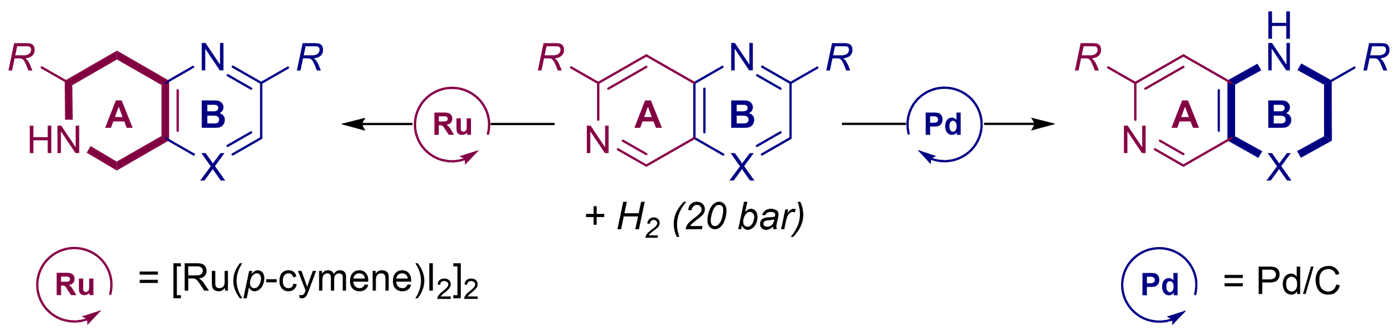
Switchable and ring-selective hydrogenation of naphthyridine isomers
Hydrogenation of heteroarenes at a late-stage remains a challenge due to the complexity of controlling regioselectivity. Orthogonal procedures for the hydrogenation of [1,6]- and [1,7]-naphthyridines to their respective 1,2,3,4- or 5,6,7,8-tetrahydronaphthyridine counterpart are described, controlled through the use of a heterogeneous palladium catalyst or homogeneous ruthenium pre-catalyst – [Ru(p-cymene)I2]2. The procedures were applied to a wide range of [1,6]- and [1,7]-naphthyridines, tolerating a wide range of substitution patterns and functional groups without impacting selectivity. In certain cases, the addition of NaBArF4 (BArF4 = tetrakis[3,5-bis(trifluoromethyl)phenyl]borate) improved activity substantially. Mechanistic studies rule out reaction pathways involving a selective product inter-conversion step and indicate the two catalyst systems directly hydrogenate their respective ring. A rationale for the selectivity is provided, where for the ruthenium system selectivity is largely controlled through electronics of the rings, and the palladium system involves a subtle mixture of steric and electronic effects. Together, the two protocols allow for the selective and predictable reduction of naphthyridine rings.