Heavy Pnictogen Dipyrrins for Photochemical Applications
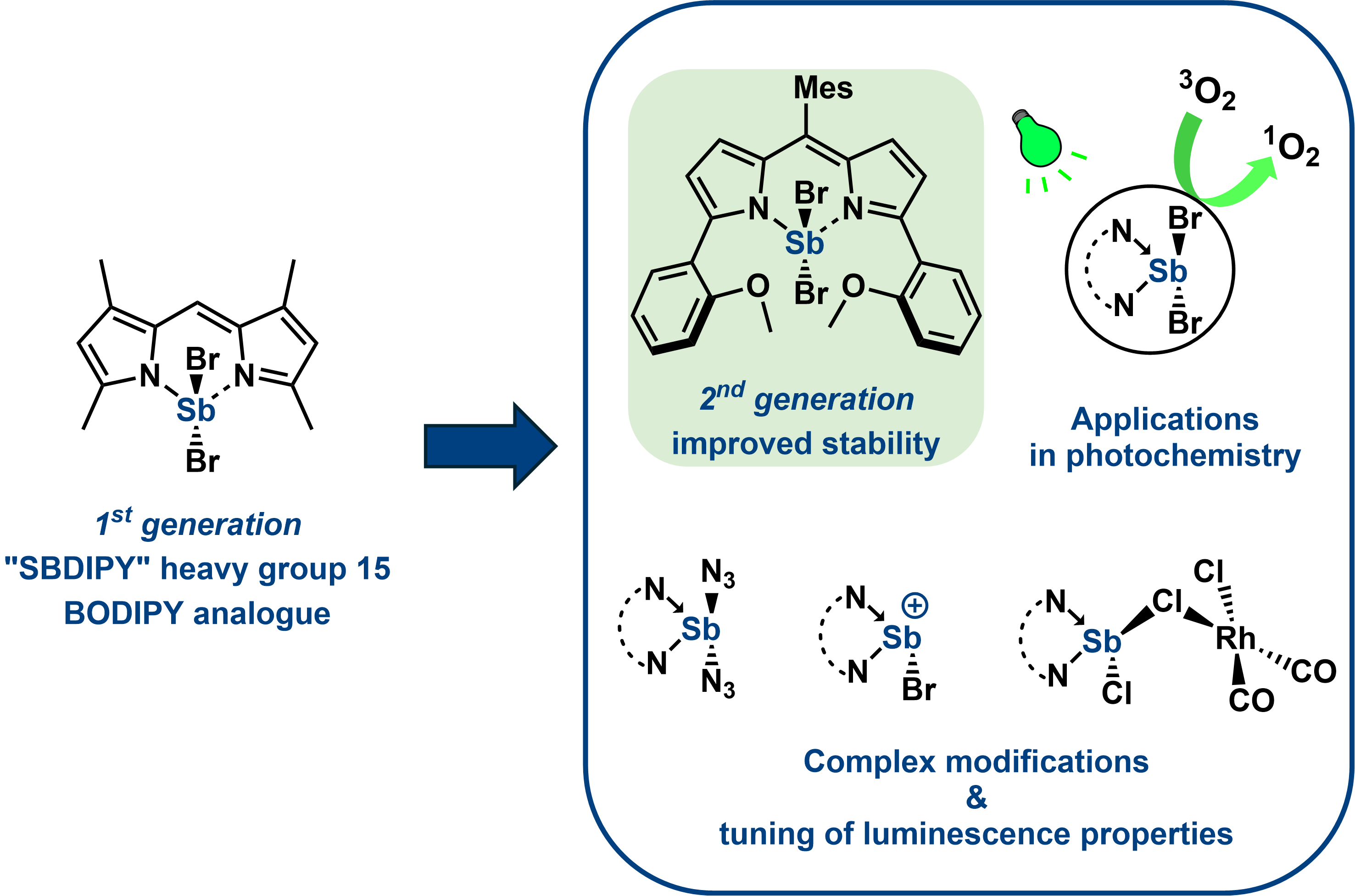
Boron-based dipyrrin chromophores (BODIPY) have found widespread applications in fields beyond synthetic chemistry due to their highly tuneable emissive features.[1] Despite advances in the field, dipyrrin complexes with different central atoms are considerably less studied. Recently, we reported the synthesis and characterization of novel chromophores based on the heavy pnictogens antimony and bismuth.[2] Spectroscopic studies through VT-UV/Vis and fluorescence spectroscopies revealed a temperature dependent decomposition event. Unfortunately, the resulting low stability of these chromophores has hindered any further applications. The current work highlights a new generation of heavy pnictogen dipyrromethene complexes with improved stability thanks to changes in the ligand design.[3] The most stable Sb-complex was found to perform especially well as a photosensitizer for singlet oxygen (1O2), achieving 1O2 quantum yields as high as ΦΔ = 0.76. Furthermore, methods for complex modification through halide substitution and metal coordination are described, along with their effects on photoluminescence properties.
References
[1] Aurore Loudet, Kevin Burgess, Chemical Reviews, 2007, 107, 4891–4932.
[2] André Korzun, Stefano Crespi, Christopher Golz, Alessandro Bismuto, Chemical Science, 2023, 14, 6579–6584.
[3] André Korzun, Morgan Jac McKee, Hagen Neugebauer, Ori Green, Gregor Schnakenburg, Stefan Grimme, Nikolay Kornienko and Alessandro Bismuto, manuscript submitted.